How overwater bungalow construction engineering in Bora Bora really works
From a sun lounger, the overwater bungalows of Bora Bora look effortless. In reality, every villa on stilts is the result of months of work by structural engineers, architects and marine contractors modelling loads, currents and wind patterns to keep each unit stable in deep water. When you book a stay in one of these iconic overwater villas, you are stepping onto a finely tuned piece of marine infrastructure rather than a simple island cabin.
The story starts in the lagoon of Bora Bora, where the first overwater bungalow in French Polynesia appeared in the late 1960s, using timber posts and pandanus thatched roofs close to shore. Those early structures launched a trend that now counts roughly 7,000 overwater bungalows worldwide, with Bora Bora and the Maldives competing for the most photogenic skyline of stilted suites.1 That global estimate comes from industry reporting rather than a formal census, so it should be treated as an informed approximation. Today’s resorts in French Polynesia still honour traditional materials such as wood and thatch, but they combine them with marine-grade steel, reinforced concrete and engineered floor systems designed for decades of saltwater exposure.
On a remote motu, engineers begin by surveying the lagoon floor to map coral heads, sand channels and water depth. They then determine precise pile locations so that each overwater villa stands clear of live coral, limiting environmental impact while still delivering that private deck suspended above turquoise water. Local construction firms, environmental consultants and resort developers work together, because building overwater accommodation in Bora Bora means balancing guest expectations, the marine ecosystem and strict regulations protecting French Polynesia’s reefs.
Foundations in the lagoon: pylons, coral and cyclone forces
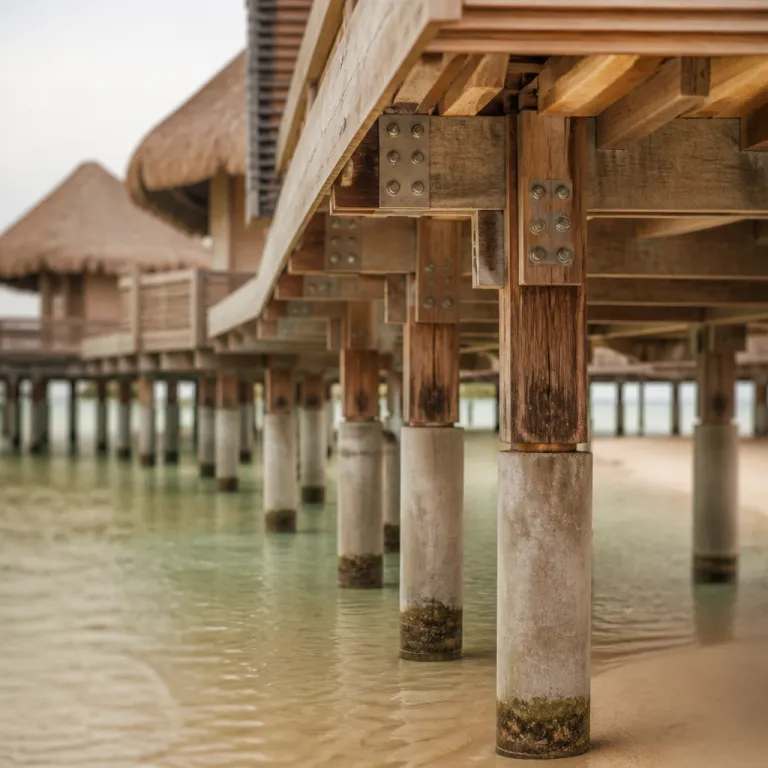
Foundation engineering is where the technical side of Bora Bora’s overwater architecture becomes most visible to specialists, even if guests never see it. Each bungalow rests on a grid of piles driven into the lagoon floor, usually a mix of sand and dead coral rubble rather than living reef structures. Typical reinforced-concrete or steel piles range from about 6 to 15 metres in length, depending on lagoon depth and geotechnical conditions, and are designed to resist both vertical and lateral loads. Engineers calculate the loads from the villa, the deck, guests, furniture and even filled plunge pools, then add safety margins for cyclone-force winds, storm surge and wave uplift.
Marine-grade steel or reinforced concrete pylons are installed using piling systems mounted on barges or transformable unmanned surface vehicles that can manoeuvre in shallow water with minimal disturbance. The goal is to anchor the resort’s overwater platforms securely without crushing the coral gardens that define the island’s marine environment and attract travellers from the United States and beyond. Environmental consultants monitor turbidity and noise during construction, while divers guide pylon placement around bommies and advise when to pause work to protect sensitive species.
Once the piles are in place, precast concrete caps and beams create a rigid frame that supports the bungalow and its glass floor panels, terraces and thatched roofs. Engineers design these frames to flex slightly under wave action rather than crack, which is crucial for long-term durability in open-ocean swells that occasionally wrap into Bora Bora’s lagoon. When you stand on a private deck at a luxury resort and feel nothing but stillness, you are experiencing the success of this invisible structural choreography.
For travellers planning to book a high-end stay, this foundation work matters more than it seems. A well-engineered overwater villa on a private motu will ride out cyclone season with minimal movement, protecting both guests and the marine life beneath. When you compare hotels and villas, ask how recently the overwater structures were inspected or upgraded, because in Bora Bora, the age and condition of the engineering can be as important as interior design.
For honeymooners eyeing a classic lagoon view, properties such as Four Seasons Bora Bora have invested heavily in resilient overwater villas that combine deep-driven piles with careful siting in naturally sheltered parts of the lagoon. If you are weighing that property for a special trip, this detailed guide to a Four Seasons Bora Bora honeymoon on the island’s most iconic lagoon explains how its location and engineering translate into calmer water under your bungalow. Understanding these structural choices helps you match your risk tolerance and comfort expectations with the right resort.
Material science over water: wood, metal, glass and thatch
Salt, humidity and tropical sun are relentless, so the engineering behind Bora Bora’s stilted villas is as much about material science as it is about romance. Original bungalows used local timber, coconut trunks and pandanus thatched roofs, which blended beautifully with the island landscape but required constant maintenance. Modern resorts still favour timber cladding and thatch for aesthetic warmth, yet the structural skeleton now relies on reinforced concrete, stainless steel fixings and engineered floor panels that resist rot and corrosion.
Every material touching water or salt spray is chosen for a specific reason, from marine-grade bolts that secure the deck to UV-treated glass in the signature glass floor windows. These glass floor panels must withstand not only the weight of guests but also thermal expansion, wave-driven pressure changes and the occasional impact from floating debris in the lagoon. Engineers specify laminated safety glass with sealed edges, while architects work the panels into layouts that frame the marine environment below without compromising structural integrity.
Metal components on an overwater villa, from railings to stair brackets, are typically stainless steel or hot-dip galvanized steel, yet even these construction materials need protective coatings and regular inspection. Timber elements such as the deck, pergolas and interior floors are often tropical hardwoods or treated softwoods, selected for density and resistance to termites and fungi. Under the thatched roofs, vapour barriers and hidden metal substructures keep the bungalow dry, while solar panels on some villas quietly harvest energy from the intense Bora Bora sun to offset air-conditioning loads.
As overwater villas have evolved, so has the guest experience they support. This detailed look at glass floors, private pools and butler service in Bora Bora overwater villas shows how design upgrades sit on top of increasingly sophisticated engineering. When you compare hotels and resorts in Bora Bora with those in the Maldives, pay attention to how much glass, how many plunge pools and how extensive the decks are, because each feature adds weight and complexity to the underlying structures. The most successful resorts are those where the engineering quietly supports indulgence without ever drawing attention to itself.
Climate resilience and environmental impact in a fragile lagoon
Today, the design of Bora Bora’s overwater accommodation sits at the intersection of climate resilience and environmental responsibility. Cyclone seasons are becoming less predictable, and rising sea levels subtly change how waves and currents move through the lagoon. Engineers respond by raising finished floor levels, reinforcing connections between bungalows and walkways, and designing breakaway elements on the deck that can fail safely without tearing at the main structures.
Environmental impact is assessed long before the first pile is driven into the lagoon floor. Developers commission marine environment studies that map coral, seagrass and fish nurseries, then adjust the layout of overwater bungalows to avoid the richest habitats. Efforts are made to minimise impact through careful planning: concentrating walkways over sand channels, spacing villas to maintain water circulation and sometimes sacrificing a few prime postcard angles to protect reef health.
Some of the most forward-thinking resorts in French Polynesia are experimenting with lower-energy systems and smarter construction materials. InterContinental Bora Bora Resort & Thalasso Spa, for example, pioneered deep ocean water cooling for air conditioning, drawing cold seawater from depth to reduce energy use by up to 90 percent compared with conventional chillers, according to the resort’s published data and technical summaries.2 Other properties are adding discreet solar panels on back-of-house roofs or even on select overwater villas, trimming their carbon footprint while still delivering the chilled champagne and flawless spa experiences guests expect.
For travellers comparing Bora Bora with the Maldives, the question of environmental impact should sit alongside price and design. Both destinations offer overwater villas on private islands, yet lagoon depth, tidal range and storm patterns differ, which shapes how resorts approach construction and long-term maintenance. When you book, look for hotels that publish reef restoration projects, water-quality monitoring or partnerships with marine biologists, because these signals usually correlate with more thoughtful overwater engineering in Bora Bora and beyond.
Maintenance, operations and what it really costs to keep bungalows standing
Once the Instagram shots fade, the story of Bora Bora’s stilted suites becomes one of relentless maintenance. Saltwater creeps into every joint, UV light attacks sealants and the constant motion of water under the structures slowly works on connections. Resorts budget significant annual sums per bungalow for inspections, repainting, timber replacement and mechanical servicing, far more than for equivalent villas on land; industry interviews commonly cite maintenance and capital-reserve costs in the tens of thousands of US dollars per overwater villa each year, though exact figures vary by brand and location.
Engineers and maintenance teams follow strict cycles, inspecting piles, beams and deck fixings after major swells or cyclones. Divers check for scouring around pylon bases, where water movement can erode sand and expose more of the construction materials than intended, potentially affecting stability. Inside each overwater villa, staff monitor for condensation around glass floor panels, corrosion on metal fittings and any movement in floor levels that might signal structural issues.
Guests rarely see this work, yet it directly shapes the quality of their stay. A well-maintained overwater bungalow feels solid underfoot, with doors that close cleanly, silent air conditioning and a deck free of splinters or soft spots. When you compare hotels and resorts in Bora Bora, recent renovation dates matter; a property that has just completed a full overwater rebuild, such as a comprehensive project involving more than one hundred villas at a leading international brand, will usually deliver a crisper experience than a resort waiting for its next major cycle.
For business-leisure travellers extending a work trip, reliability is non-negotiable. You may need stable Wi‑Fi for calls, quiet air conditioning for sleep and safe access to the water for a quick swim between meetings. Choosing a resort that invests heavily in maintenance, even if the nightly rate is higher, often delivers better value than chasing the lowest price on an ageing overwater structure.
What this means for your booking: choosing the right overwater experience
Understanding how Bora Bora’s overwater bungalows are engineered helps you make sharper booking decisions. Not every villa on stilts is equal, and the differences often start with how and where the structures were built. When you browse options on Stay in Bora Bora–style platforms, look beyond the headline photos and read carefully for clues about engineering, renovation and environmental commitments.
If you prioritise calm water and easy swimming, focus on resorts where overwater bungalows sit inside the main reef, sheltered from direct ocean swell. Properties on a remote motu may offer more privacy and wider lagoon views, yet they can also feel more exposed to wind and waves, which matters if you are sensitive to movement or noise. For guests who love water sports such as kitesurfing, paddleboarding or kayaking, a resort with direct access to steady trade winds and flat water can be a better fit than the most enclosed lagoon corner.
To understand how engineering and geography shape those experiences, this in-depth guide to kitesurfing the Bora Bora lagoon with flat water and trade winds is a useful companion. It shows how channels, reef passes and wind exposure vary around the island, which is exactly the same data engineers use when planning resort overwater layouts. When you align your personal preferences with these physical realities, you end up in a bungalow where the engineering quietly amplifies your version of paradise.
Finally, consider how your stay fits into a wider travel pattern. If you are pairing Bora Bora with the Maldives, or even a Maldives–Bora cruise itinerary, you will experience different interpretations of the same overwater idea, shaped by local construction materials, regulations and marine-environment constraints. Let those contrasts guide your choices, and you will return not just with photos of a glass floor over neon fish, but with a deeper appreciation of the engineering that made your island escape possible.
Key figures behind Bora Bora’s overwater engineering
- Around 7,000 overwater bungalows exist worldwide, according to reporting in Architectural Digest, with Bora Bora and the Maldives representing two of the highest concentrations of resort inventory built directly over lagoons.1 This is an indicative figure based on compiled industry data rather than a continuously updated global registry.
- The first overwater bungalows in French Polynesia were developed in the late 1960s by a group of hoteliers known as the “Bali Hai Boys”, whose early experiments on Raiatea and Moorea led to later projects at Hotel Bora Bora and beyond.3 Historical accounts from regional tourism archives and interviews with the founders provide the main documentation for this origin story.
- InterContinental Bora Bora Resort & Thalasso Spa’s deep ocean water cooling system has been reported to cut air-conditioning energy consumption by up to 90 percent compared with conventional systems, significantly lowering the environmental impact of each overwater villa.2 The percentage is drawn from the resort’s own technical notes and partner engineering case studies.
- Major rebuilds at leading Bora Bora resorts typically involve replacing piles, decks, thatched roofs and interior fit-outs in a single multi‑year project, allowing engineers to update structural details to current cyclone and building standards. Project documentation often notes phased closures over two to three low seasons to complete this work.
- Foundation surveys for new overwater structures routinely map lagoon depths from less than 1 metre near shore to more than 10 metres near reef edges, which directly influences pile length, construction methods and long-term maintenance strategies. In deeper sections, engineers may specify thicker piles or additional bracing to manage lateral forces.
FAQ about overwater bungalow engineering in Bora Bora
When were the first overwater bungalows built in Bora Bora ?
The first overwater bungalows in French Polynesia were built in the 1960s by a group of hoteliers known as the “Bali Hai Boys”. They initially experimented on other Society Islands before adding overwater units at Hotel Bora Bora, which helped cement the island’s reputation for lagoon-based luxury.3 Those early bungalows used simple timber piles and traditional thatched roofs, yet they established the template for today’s far more engineered structures.
What construction materials are used for modern overwater villas ?
Modern overwater villas in Bora Bora typically combine reinforced concrete piles, marine-grade steel connectors and treated timber or composite decking. Superstructures often use hardwood or engineered wood for walls and ceilings, topped with pandanus or synthetic thatched roofs for a classic Polynesian look. Inside, laminated glass floor panels, corrosion-resistant fixtures and high-efficiency insulation help the villas withstand constant exposure to salt, humidity and strong sun.
How do overwater bungalows impact the marine environment ?
Overwater bungalows can affect the marine environment through shading, construction noise, sediment disturbance and changes in water flow. Responsible resorts mitigate these impacts by siting piles on sand rather than live coral, spacing structures to maintain circulation and scheduling noisy work outside sensitive breeding periods. Environmental consultants are often involved from the design phase, and many properties now pair construction with coral gardening or reef restoration programmes.
How are pylons installed without damaging coral reefs ?
Before any piling begins, engineers and marine biologists survey the lagoon floor to map coral heads and seagrass beds. Piles are then positioned in sandy gaps between coral formations, and specialised barges or small unmanned surface vehicles drive them in with precision to avoid direct contact with living reef. During the process, divers monitor alignment in real time and can halt work if sediment plumes or accidental contact threaten nearby coral.
Why do overwater bungalows cost more than beachfront villas ?
Overwater bungalows cost more to build and maintain than comparable beachfront villas, which translates into higher nightly rates. The need for marine-grade construction materials, complex piling operations, corrosion-resistant systems and constant inspections all add to the long-term cost base. Guests are effectively paying for both the unique location over water and the invisible engineering required to keep that location safe, stable and environmentally responsible.
References
- Architectural Digest, coverage of global overwater bungalow development and estimated inventory figures, drawing on interviews with resort developers and regional tourism boards.
- InterContinental Bora Bora Resort & Thalasso Spa, published information on deep ocean water cooling and reported energy savings, supported by partner engineering firm case studies.
- Historical accounts of the “Bali Hai Boys” and the origins of overwater bungalows in French Polynesia, including early projects at Hotel Bora Bora, compiled from local tourism histories and founder interviews.