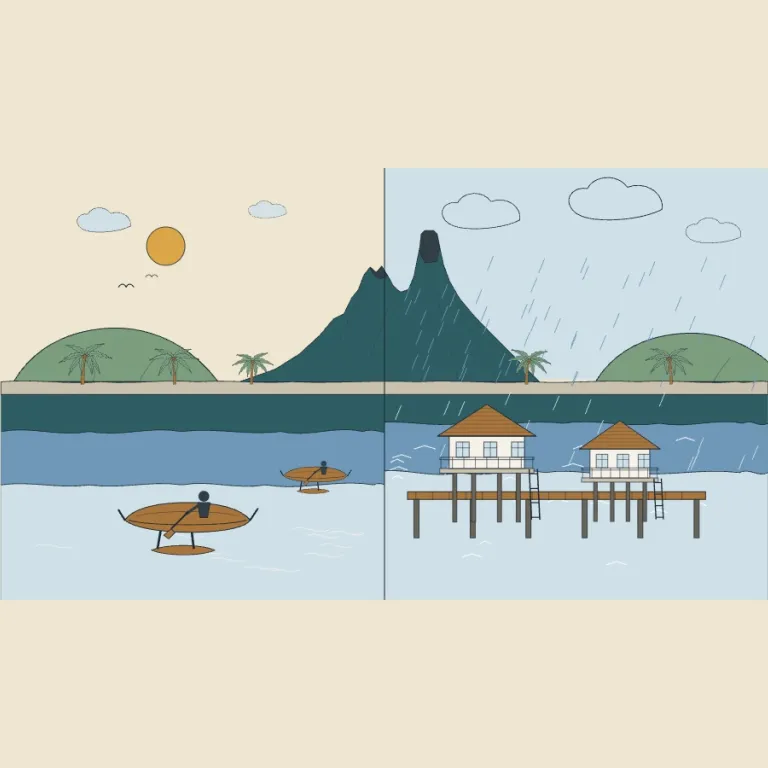
The best time to visit Bora Bora is May to October, the dry season, when the island records 2.4 to 4.4 inches (62 to 112 mm) of rain a month against 9.9 inches (251 mm) in December. Highs sit at 84 to 86 °F (29 to 30 °C), the lagoon holds 81 to 84 °F (27 to 29 °C), and the trade winds cut the humidity. Avoid December to February, the wettest and stormiest weeks. For the best value, aim at September: French Polynesia's hotels were 78.9 percent full that month in 2025, yet the average room went for 17 percent less than in August. Plan your stay on stay-in-bora-bora.com.
Bora Bora at a glance
- Best overall: May to October. Bora Bora gets only 496 mm of its 1,654 mm annual rainfall in those six months, on Météo-France normals.
- Best value: September and early October. Hotels are close to full but rates fall well below the August peak.
- Worst months: December to February. December alone averages 9.9 inches (251 mm) of rain over 16.8 rainy days.
- Driest month: July, at 2.4 inches (62 mm) over 9.4 rainy days. Wettest: December.
- Warmest air: March, at 89 °F (31.4 °C). Coolest: July and August, at 84 °F (29 °C). The whole year spans five degrees.
- Sea temperature: never below 81 °F (27 °C) in August and September, up to 85 °F (29.4 °C) in April.
- Cyclone season: November to April, but direct hits are rare. The last one to damage Bora Bora was Cyclone Oli in February 2010.
- Busiest month: July, with 30,990 tourists across French Polynesia in 2025. Quietest: January, with 14,105.
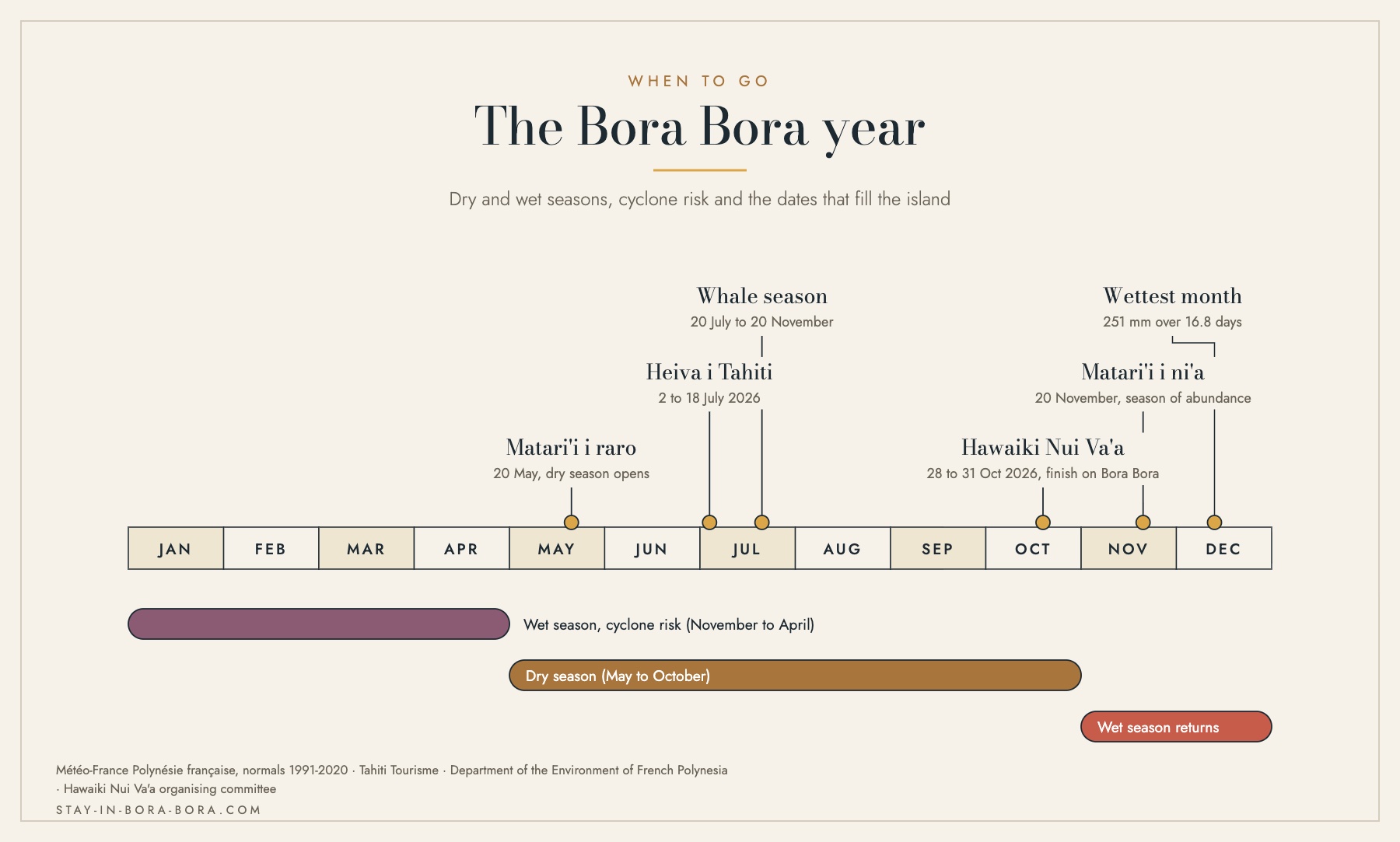
The Bora Bora year: the two seasons, the cyclone window and the dates that fill the island.
Understanding Bora Bora's climate
Bora Bora has two seasons and no winter. Météo-France Polynésie française splits the Polynesian year into a warm, humid season from November to April and a cooler, drier one from May to October. Air temperature barely takes part in that split. Rain, humidity and wind do all the work, and they change enough to make the difference between a week of open skies and a week of afternoon downpours.
The Polynesian calendar says the same thing
Tahitian tradition divides the year at the Pleiades, called Matari'i. The constellation rises on 20 November and opens Matari'i i ni'a, the season of abundance, which is also the rainy season: the land fruits, the fish return. It sets on 20 May and opens Matari'i i raro, the season of scarcity, which lines up with the dry, cooler half of the year. Tahiti Tourisme still marks both dates. The calendar built for growing food and the calendar built for booking a bungalow point in opposite directions, which is worth knowing before you read any local source.
Temperature moves five degrees, rainfall moves fourfold
Bora Bora's average high runs from 84 °F (28.9 °C) in July to 89 °F (31.4 °C) in March, on the Météo-France normals for 1991 to 2020 at the island's own station. Nights sit between 75 °F (23.9 °C) and 78 °F (25.8 °C). That is a five-degree year, and it is why nobody chooses a month in Bora Bora for the heat.
Rainfall is the opposite. The island averages 1,654 mm (65 inches) a year, and 1,158 mm of it, 70 percent, falls between November and April. December alone brings 251 mm, four times July's 62 mm. Rainy days follow: 17.2 in January against 8.8 in August.
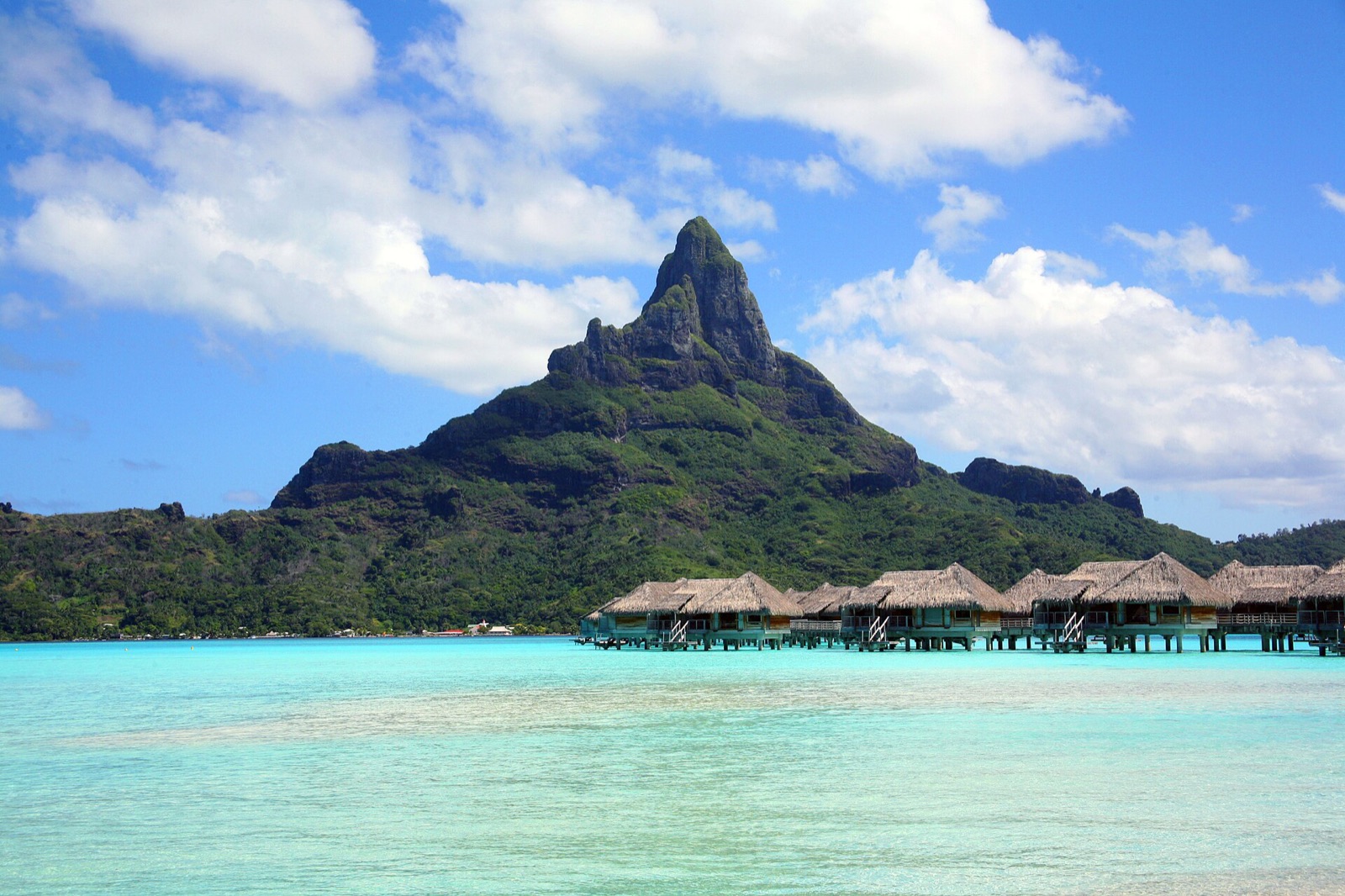
Mount Otemanu above the lagoon. The island's average high moves only five degrees across the whole year. Photo : Taka-0905, derivative work by Alvaro qc, Wikimedia Commons, CC BY-SA 3.0.

Bora Bora is wetter than Tahiti, and cloudier
Bora Bora sits northwest of Tahiti, in the Leeward Islands, and the two run nearly identical thermometers. Faa'a, on Tahiti, records a March high of 31.5 °C against Bora Bora's 31.4 °C. Rainfall totals are close too: 1,579 mm a year at Faa'a, 1,654 mm at Bora Bora. What separates them is how that rain arrives. Bora Bora records 147 days with precipitation a year, Faa'a 98. Tahiti takes its water in fewer, heavier episodes; Bora Bora takes it in more frequent, lighter ones, spread across the lagoon by the trade winds that break against Mount Otemanu and Mount Pahia.
Faa'a is also the only one of the two stations with a sunshine normal: 2,660 hours a year, peaking at 240.6 hours in August and bottoming at 187.9 hours in February. Bora Bora's station publishes no sunshine normal, so Tahiti's is the nearest measured series, and it puts the brightest weeks of the year in July and August.
The lagoon is warm in every single month
Sea surface temperature around Bora Bora runs from 81 °F (27.1 °C) in August and September to 85 °F (29.4 °C) in April, on NOAA's 2016 to 2025 averages. No month calls for a wetsuit, and a shorty is generous even in August. Water temperature is never the reason to pick a month here. Visibility is: the reef water clears when the rain stops feeding runoff into the lagoon, which is the practical argument for the dry season and for planning which lagoon stops you want in the first place.
The dry season: May to October
The dry season is the answer for most trips. Bora Bora records 62 to 112 mm of rain a month from May through September, over 8.8 to 11.4 rainy days. Humidity drops, the southeast trade winds blow steadily, and the lagoon settles into the flat, clear state the island is photographed in.
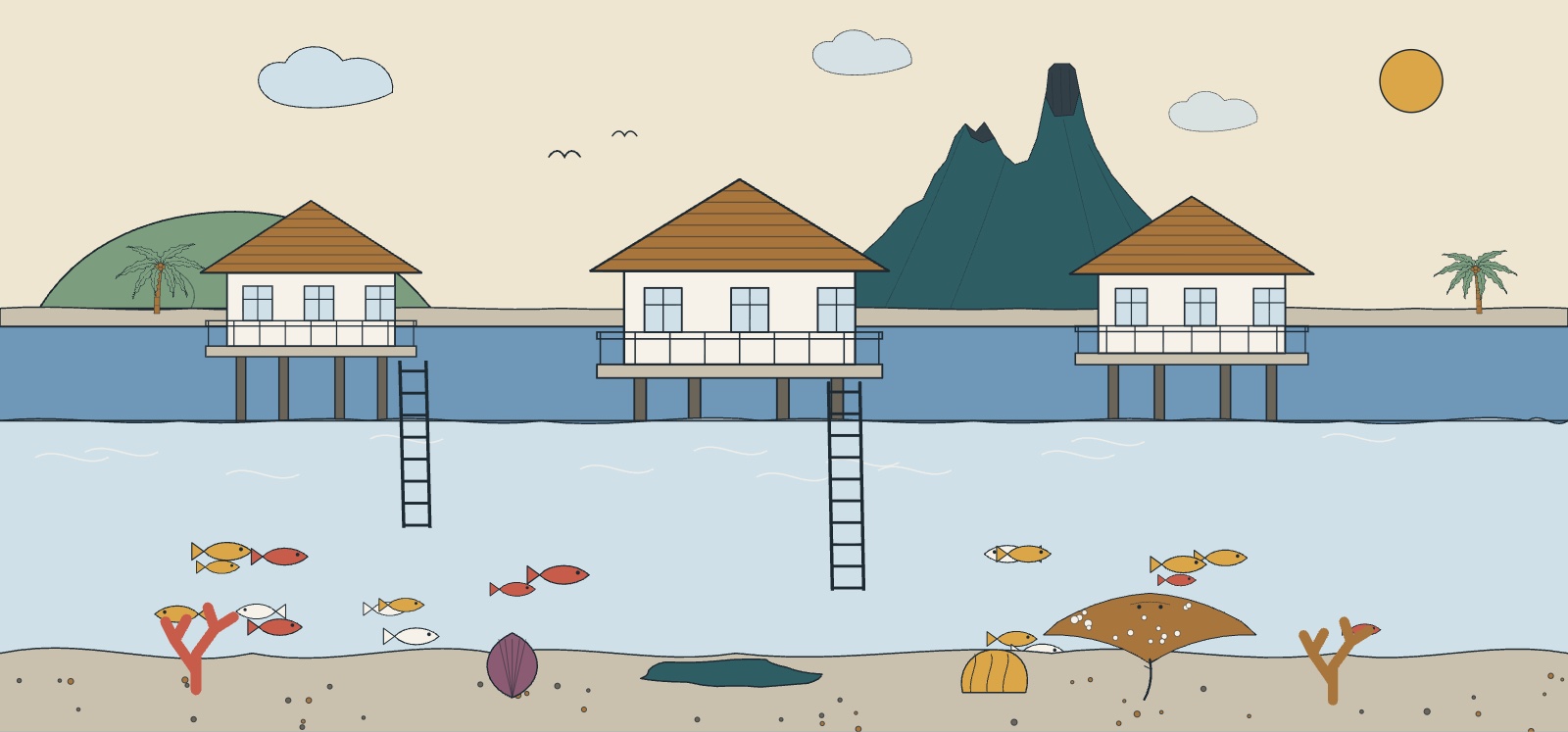
The dry season is when the lagoon settles and the water clears, from May to October. Illustration : Book Luxury & Premium Hotels in Bora Bora.
The six months are not interchangeable.
- May is the opening. Rain is already down to 4.4 inches (112 mm) over 11.4 days, the sea still holds 84 °F (28.8 °C), and hotel occupancy across French Polynesia was 72.2 percent in May 2025 against 78.9 percent in September. It is the warmest water of the dry half.
- June and July bring the driest skies. July averages 2.4 inches (62 mm), the lowest of the year. July is also the busiest month in the territory: 30,990 tourists in 2025, the annual peak, on the ISPF count of arrivals for the whole of French Polynesia.
- August is the peak for prices. The average room in French Polynesia's international hotels went for 85,452 XPF a night in August 2025, about $821, the highest of the year and 63 percent above February. Rain stays low at 2.5 inches (64 mm), the sea cools to its yearly floor of 81 °F (27.1 °C), and the rooms that sell first are long gone.
- September is the month to target. Occupancy hit 78.9 percent, the highest of 2025, yet the average rate fell to 71,321 XPF, about $685, a 17 percent drop from August. Rain holds at 2.5 inches (65 mm), and humpback whales are still in Polynesian waters. Our note on the quiet weeks of the shoulder season covers what that looks like on the water.
- October is the turn. Rain climbs to 4.3 inches (109 mm) over 10.6 days, occupancy stays high at 78.2 percent, and the Hawaiki Nui Va'a canoe race finishes on the island at the end of the month.
Two practical points. The trade winds that make the dry season pleasant on land also make the lagoon choppy on its eastern side, which matters if your bungalow faces that way: our guide to the sunrise and sunset sides explains the trade-off. And nights genuinely cool in July and August, to 75 °F (23.9 °C), so dinner over the water asks for a light layer.
The wet season: November to April
The wet season is not a write-off, but it is a different island. Bora Bora records 138 to 251 mm a month from November through February, over 12.3 to 17.2 rainy days. Rain usually arrives as a heavy afternoon or overnight burst rather than an all-day drizzle, but the humidity does not let up and the ground stays wet. This is the rainy season in the fullest sense of the word, and it changes what the island feels like more than the temperature chart suggests.
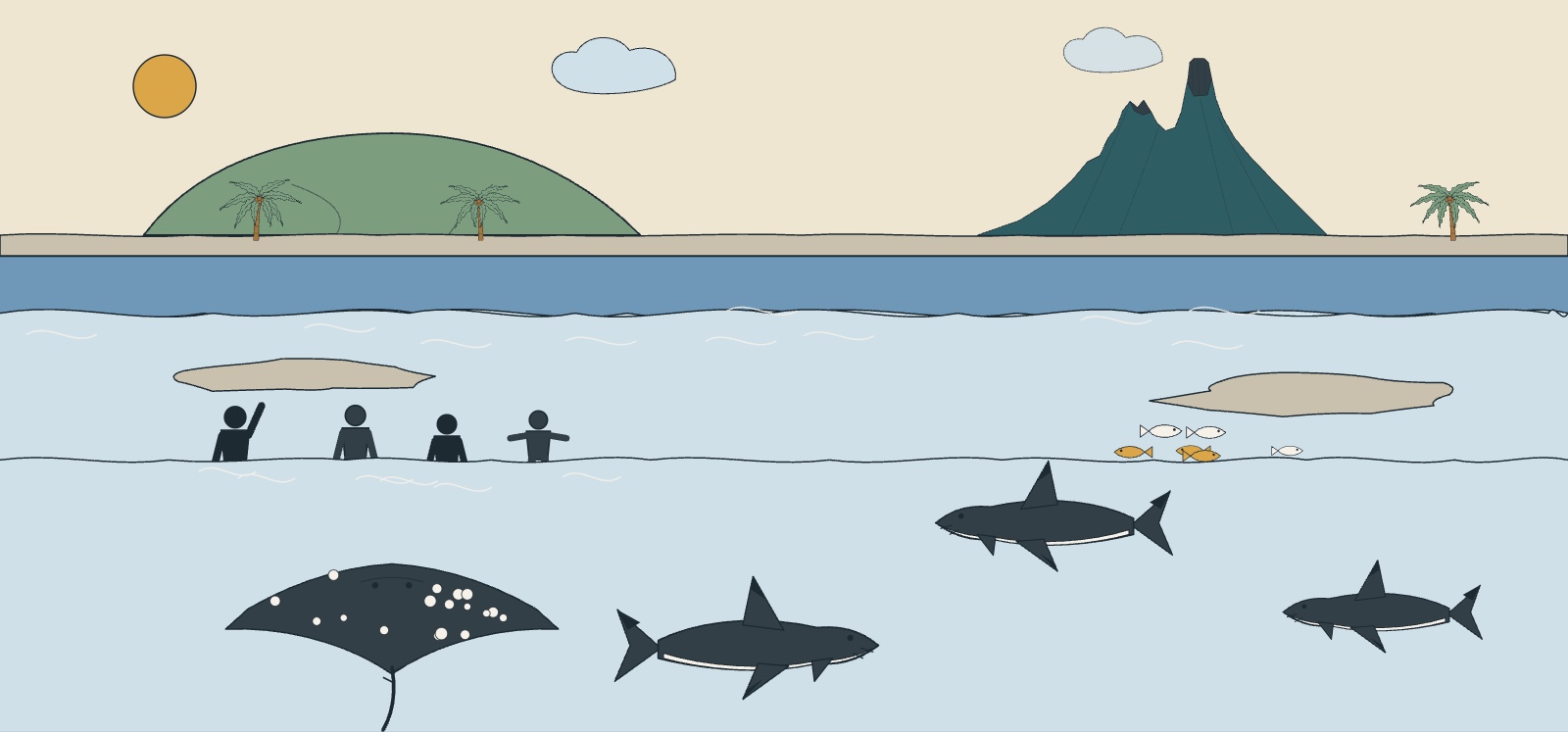
The lagoon works in every season: rays and blacktip sharks stay on the shallow sand flats all year. Illustration : Book Luxury & Premium Hotels in Bora Bora.
What the season gives you:
- The warmest water of the year, 85 °F (29.4 °C) in March and April.
- The emptiest island. French Polynesia received 14,105 tourists in January 2025 against 30,990 in July, less than half.
- The lowest rates. The average hotel room went for 52,351 XPF, about $503, in February 2025, the cheapest month of the year, with occupancy at 58.5 percent.
- Green mountains and full waterfalls on the interior tracks, which the dry months cannot offer.
What it costs you:
- Cyclone risk, covered below, plus the travel insurance question that comes with it.
- Lagoon visibility, reduced by runoff after heavy rain, which affects snorkeling and photography more than diving.
- Heat that does not break at night. January and February lows sit at 78 °F (25.4 °C).
- Cancelled excursions. Lagoon tours and motu picnics are weather calls, and a wet week can cost you two or three of them.
Two windows inside the wet season are worth singling out. November is still mild at 5.5 inches (139 mm) over 12.3 days, with rates at $612 and the Matari'i i ni'a celebrations on the 20th. March and April dry out fast, from 6.6 inches to 5.7 inches, and April brings the warmest sea of the year with occupancy back up to 71.8 percent. April is the shoulder month most Bora Bora regulars name, and the numbers back them.
Cyclones: what the risk actually is
The South Pacific cyclone season runs November to April, and it matches the warm season Météo-France Polynésie française defines for the territory. French Polynesia sits at the eastern edge of the basin, far from the corridor that hits Fiji and Vanuatu every year, and most seasons pass with nothing worse than heavy rain and a few days of swell.
The exceptions are real and they cluster in strong El Niño years. The 1982 to 1983 season brought nine tropical depressions, six of them at cyclone strength, and 15 deaths across the territory, according to the ORSTOM review of that season published in Disasters. Tropical storm Lisa, on 12 to 14 December 1982, named Bora Bora, Raiatea and Tahiti among its worst-hit islands. More recently, Cyclone Oli in February 2010 brought gusts to 75 mph (120 km/h) to Bora Bora and destroyed 40 homes on the island, while a swell death and heavier damage hit Tubuai in the Australs.
The practical rules:
- The safest wet-season weeks are November and early December, ahead of the January to March peak in sea surface temperature.
- Take insurance covering weather disruption for any trip between November and April, and read the resort's own storm policy before you pay a deposit.
- Watch Météo-France Polynésie française, which issues the territory's cyclone alerts and publishes a seasonal outlook before each season opens.
- Keep a buffer day on Tahiti on the way home in the wet months. Inter-island flights are the first thing weather stops and the last to restart.
Bora Bora month by month
This table is the year in one view. Air temperature and rain are the Météo-France normals for the Bora Bora station itself, not a regional average. Sea temperature is NOAA's, off the lagoon. The last two columns are territory-wide: the ISPF publishes arrivals and hotel figures for the whole of French Polynesia, not island by island, so read them as the shape of the season rather than as a Bora Bora count.
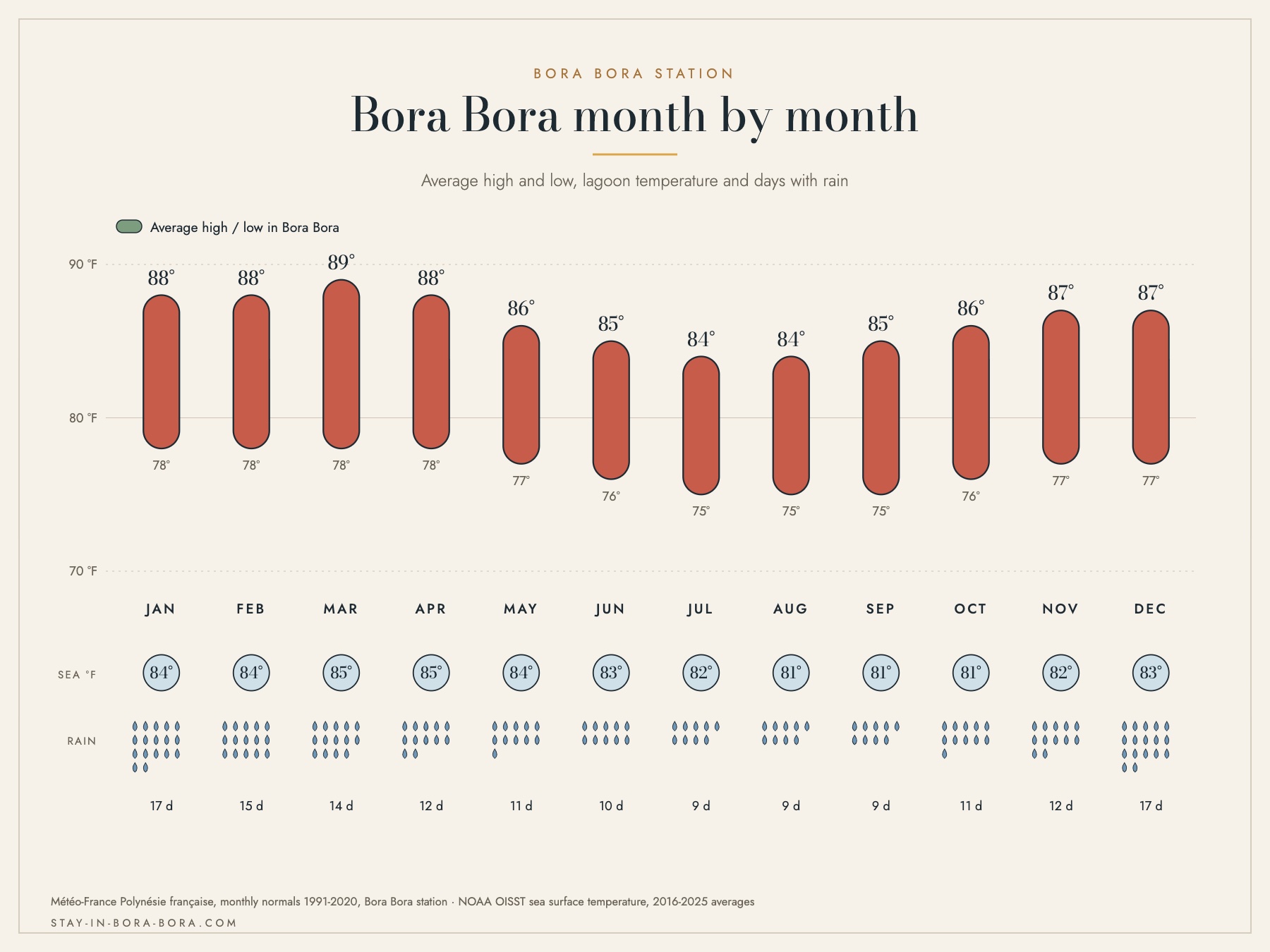
Bora Bora month by month, on the Météo-France normals for the island's own station.
| Month | High / Low °F (°C) | Sea °F (°C) | Rain in (mm) | Rain days | Tourists, French Polynesia 2025 | Avg room rate 2025 | In three words |
|---|---|---|---|---|---|---|---|
| January | 88 / 78 (31.1 / 25.3) | 84 (28.7) | 9.6 (245) | 17.2 | 14,105 | $566 | Wettest, emptiest, humid |
| February | 88 / 78 (31.1 / 25.4) | 84 (28.9) | 8.3 (212) | 15.3 | 17,298 | $503 | Cheapest, wet, quiet |
| March | 89 / 78 (31.4 / 25.8) | 85 (29.3) | 6.6 (168) | 14.5 | 23,002 | $530 | Hottest, drying, green |
| April | 88 / 78 (31.1 / 25.8) | 85 (29.4) | 5.7 (144) | 11.8 | 25,086 | $642 | Warm water, shoulder |
| May | 86 / 77 (30.2 / 25.2) | 84 (28.8) | 4.4 (112) | 11.4 | 24,316 | $711 | Dry, warm, opening |
| June | 85 / 76 (29.3 / 24.5) | 83 (28.2) | 3.4 (86) | 9.7 | 26,137 | $781 | Clear, breezy, busy |
| July | 84 / 75 (28.9 / 24.1) | 82 (27.5) | 2.4 (62) | 9.4 | 30,990 | $809 | Driest, coolest, packed |
| August | 84 / 75 (29.0 / 23.9) | 81 (27.1) | 2.5 (64) | 8.8 | 25,076 | $821 | Peak, dry, priciest |
| September | 85 / 75 (29.4 / 24.0) | 81 (27.1) | 2.5 (65) | 9.3 | 28,274 | $685 | Full, dry, best-value |
| October | 86 / 76 (29.9 / 24.5) | 81 (27.4) | 4.3 (109) | 10.6 | 25,775 | $721 | Dry, festive, turning |
| November | 87 / 77 (30.7 / 25.0) | 82 (28.0) | 5.5 (139) | 12.3 | 19,714 | $612 | Humid, quiet, showery |
| December | 87 / 77 (30.8 / 25.2) | 83 (28.4) | 9.9 (251) | 16.8 | 21,454 | $650 | Wettest, festive, stormy |
Air temperature, rainfall and rain days: Météo-France Polynésie française, monthly normals 1991-2020, Bora Bora station. The island totals 1,654.1 mm of rain over 147.1 days with precipitation a year. Sea: NOAA OISST, 2016 to 2025 averages for the Bora Bora lagoon area. Tourists and room rates: ISPF, monthly visitor and hotel surveys for all of French Polynesia, calendar year 2025. Rates are the average daily rate across the territory's international hotels, converted from XPF at the European Central Bank euro reference rate of 18 September 2026; the Pacific franc is pegged to the euro at 119.3317 XPF.
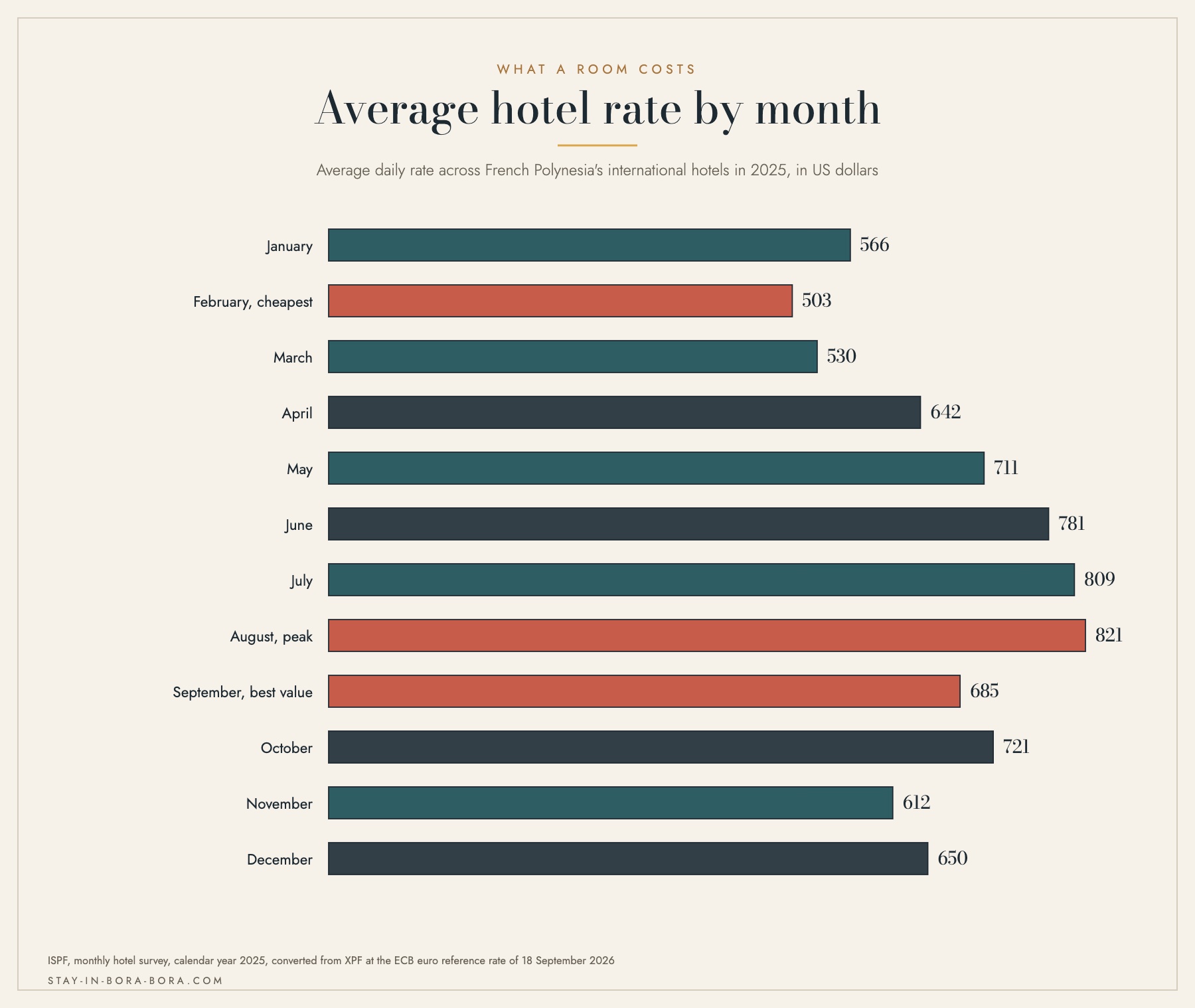
What a room costs by month: August peaks at $821, September falls to $685 with hotels fuller.
The best time for what you want to do
Bora Bora rewards matching the month to the plan, because the whale calendar, the wind calendar and the price calendar do not line up.
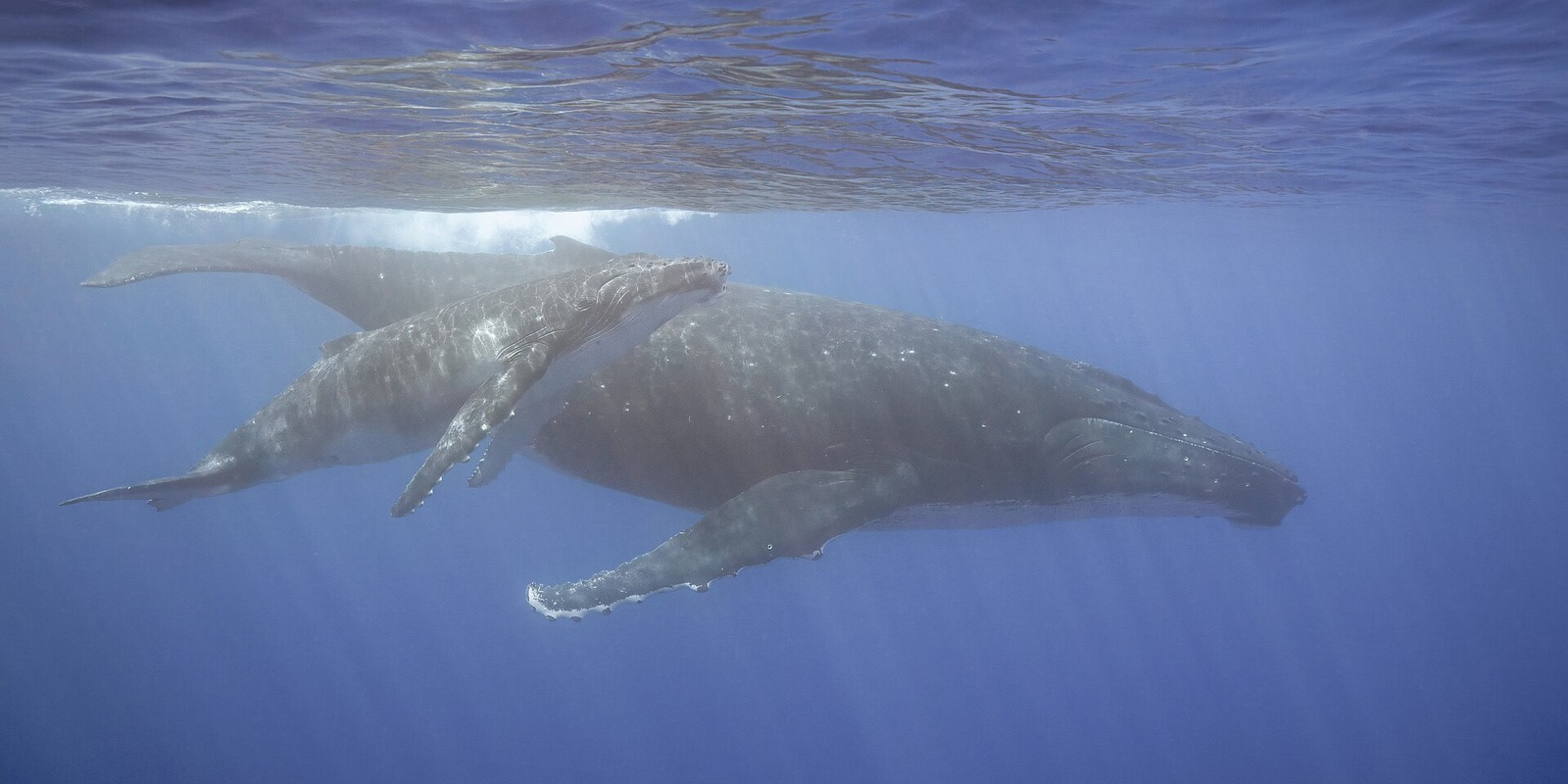
A humpback and her calf off Moorea. The season runs from 20 July to 20 November across French Polynesia. Photo : Charles J. Sharp, Wikimedia Commons, CC BY-SA 4.0.
_with_calf_Moorea.jpg)
- Swimming with humpback whales: 20 July to 20 November. French Polynesia's Department of the Environment sets those exact dates, and only approved operators may run trips. September is the month our own coverage of the humpback season singles out, before the whales head south.
- Manta rays: year round, best on a calm morning. The lagoon's resident mantas feed on the same shallow cleaning stations in every season, so finding them is a question of wind and timing, not of month.
- Snorkeling and diving: May to October. Rain feeds runoff into the lagoon, and the dry months are when the water clears. The same months are the ones to book night dives.
- Kitesurfing: June to September. The southeast trade winds are at their steadiest in the cool season, which is why the lagoon's kite spots work best then.
- Honeymoons: April, May, September, October. Warm water, dry skies and rates below the July to August ceiling. Our honeymoon planner sets out what to book first.
- Families: July and August, or September. School holidays force the first two; September gives the same weather to anyone free to travel then, and our guide to Bora Bora with kids covers what the resorts actually run.
- Budget: February and March. The cheapest rooms of the year, at the cost of the wettest weeks.
- The interior: May to October. The 4x4 tracks to the Otemanu viewpoints are mud after heavy rain, so the inland safari belongs to the dry season.
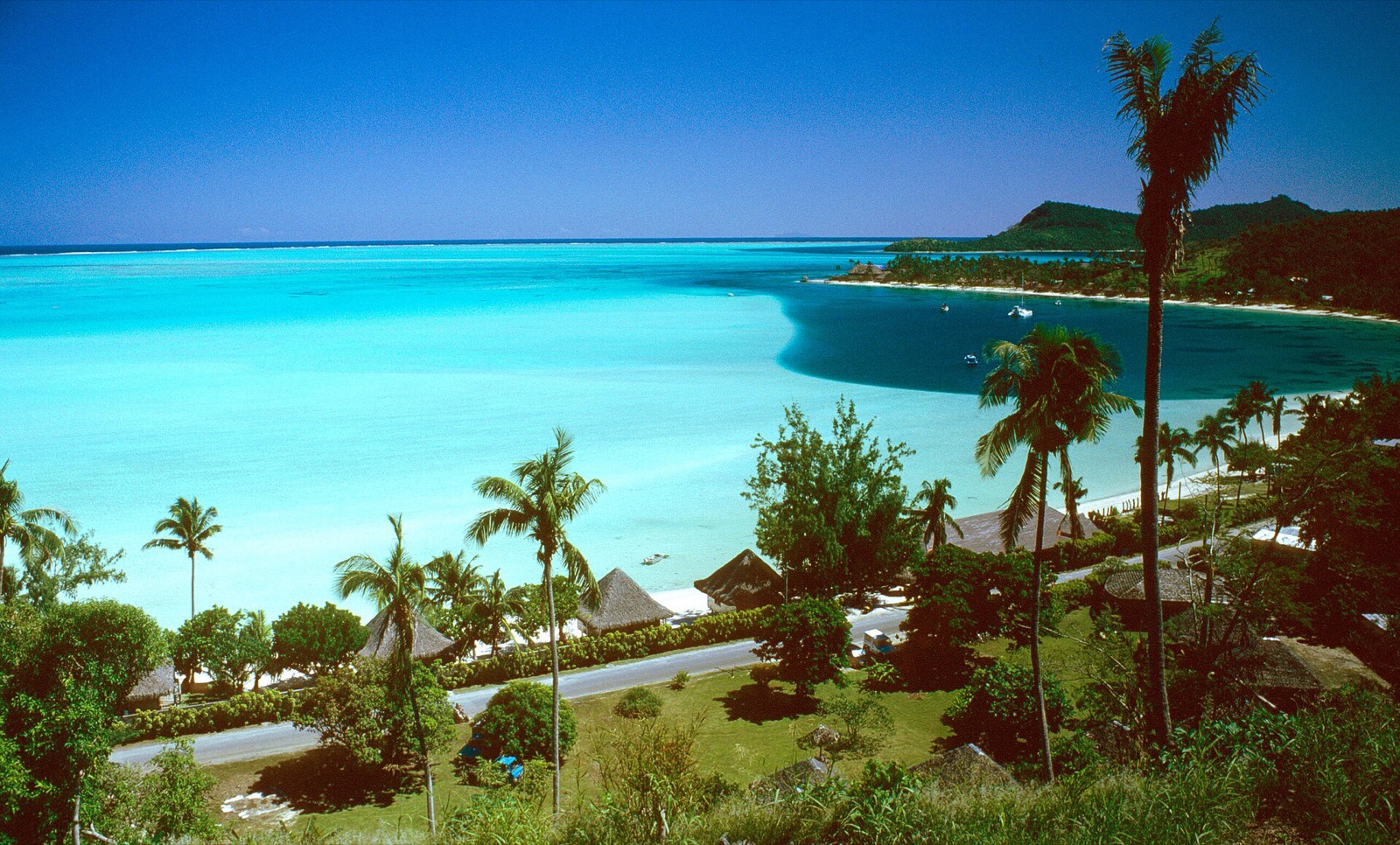
Matira, at the southern tip of the main island, where the lagoon shelves out into shallow turquoise water. Photo : Sba2, Wikimedia Commons, CC BY 2.5.

Events that shape the year
- Heiva, all through July. Heiva i Tahiti ran from 2 to 18 July 2026 at Place To'ata in Papeete, and Tahiti Tourisme dates the festival back to 1881, with tickets from 2,900 XPF. Bora Bora holds its own heiva over the same weeks, with dance competitions and va'a races in Vaitape. Our guide to Heiva explains what a visitor can and cannot attend.
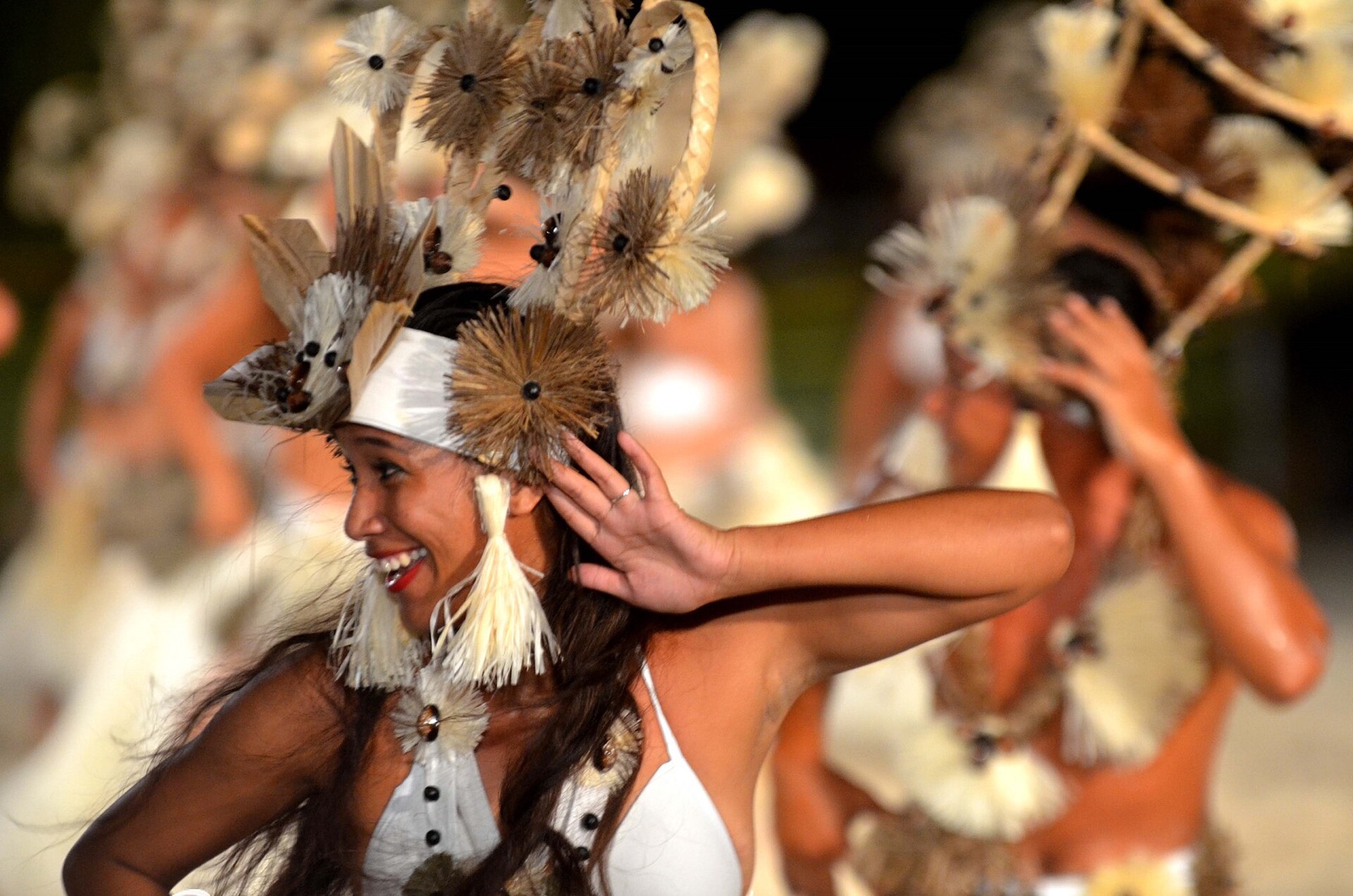
Heiva i Bora Bora. The island holds its own festival through July, alongside Heiva i Tahiti in Papeete. Photo : Moerani Manate, Wikimedia Commons, CC BY-SA 4.0.

- Hawaiki Nui Va'a, late October. The 33rd edition runs 28 to 31 October 2026, three stages of outrigger canoe racing from Huahine to Raiatea, Taha'a and a finish on Bora Bora. Hundreds of six-man crews take part, and hotel beds across the Leeward Islands go early.
- Matari'i i ni'a, 20 November. The rising of the Pleiades opens tau 'auhunera'a, the Polynesian season of abundance, which Tahiti Tourisme describes as coinciding with the arrival of the rains. Matari'i i raro, on 20 May, opens the dry, cooler half. The dates are fixed and fall either side of the tourist season.
- Christmas and New Year, late December. The wettest weeks of the year still carry a price bump. Territory-wide occupancy fell to 54.8 percent in December 2025, yet the average room rate rose to 67,723 XPF, about $650, above November's $612. Resorts price the holidays, not the weather.
Where to stay by season
The lagoon side you book matters as much as the month. The east-facing motu take the trade winds in the dry season; the sheltered west and the main island are calmer, and they sit closer to Vaitape and the restaurants.
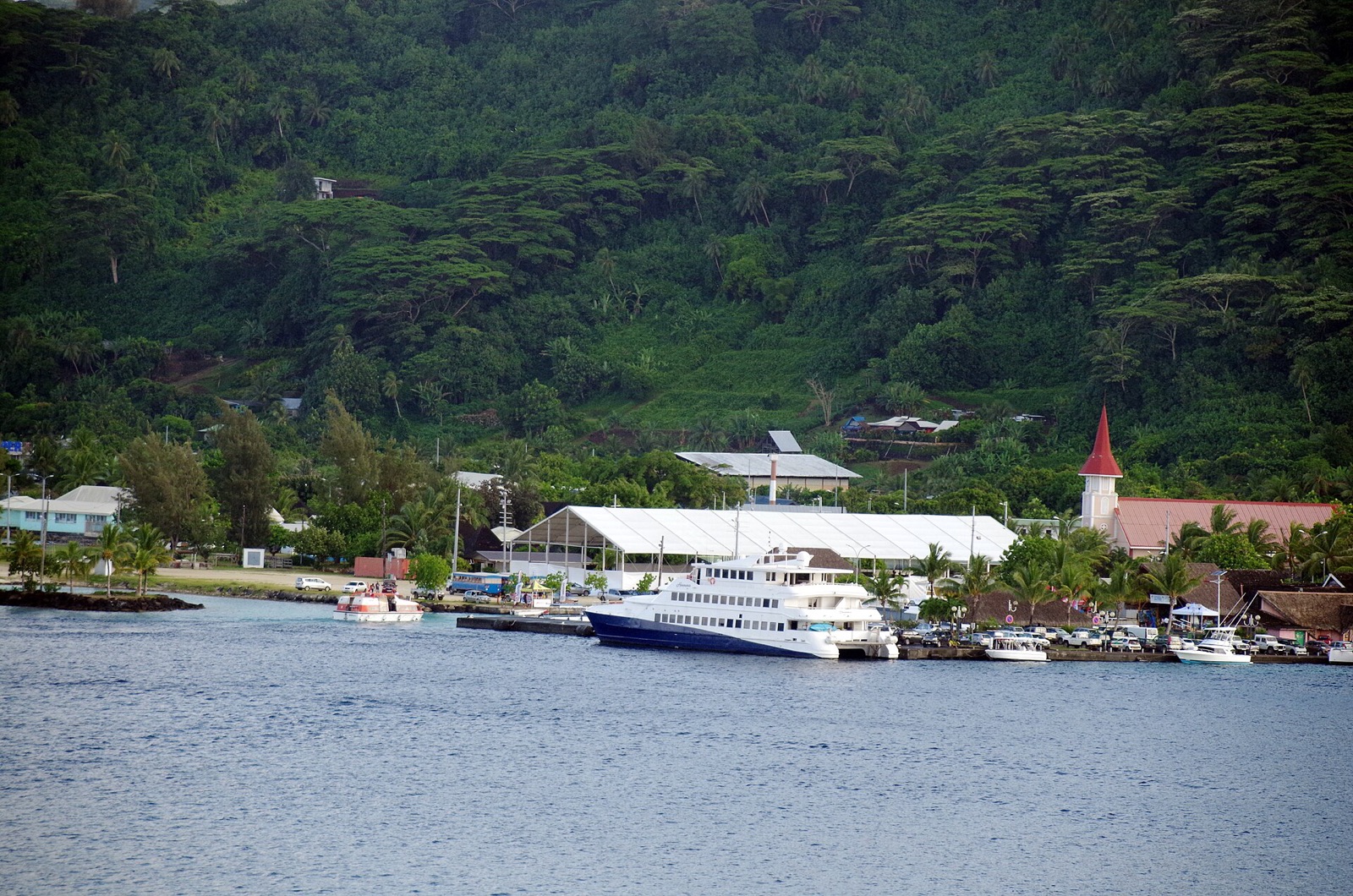
Vaitape, the island's main village and the hub for boat transfers across the lagoon. Photo : Balou46, Wikimedia Commons, CC BY-SA 4.0.

- Matira, Nunue or Faanui: the three areas of the main island, each with a different exposure to wind and swell.
- The St Regis Bora Bora: on Motu Ome'e, with the lagoonarium that holds up when the open water is choppy.
- Conrad Bora Bora Nui: reopened with sunset-facing overwater villas, on the sheltered western side.
- Le Bora Bora by Pearl Resorts: a beach resort rather than an overwater one, which reads differently in the wet season.
- Le Maitai Polynesia: on Matira, the walkable end of the island.
- The boutique alternatives: smaller properties that hold their rates more steadily across the seasons.
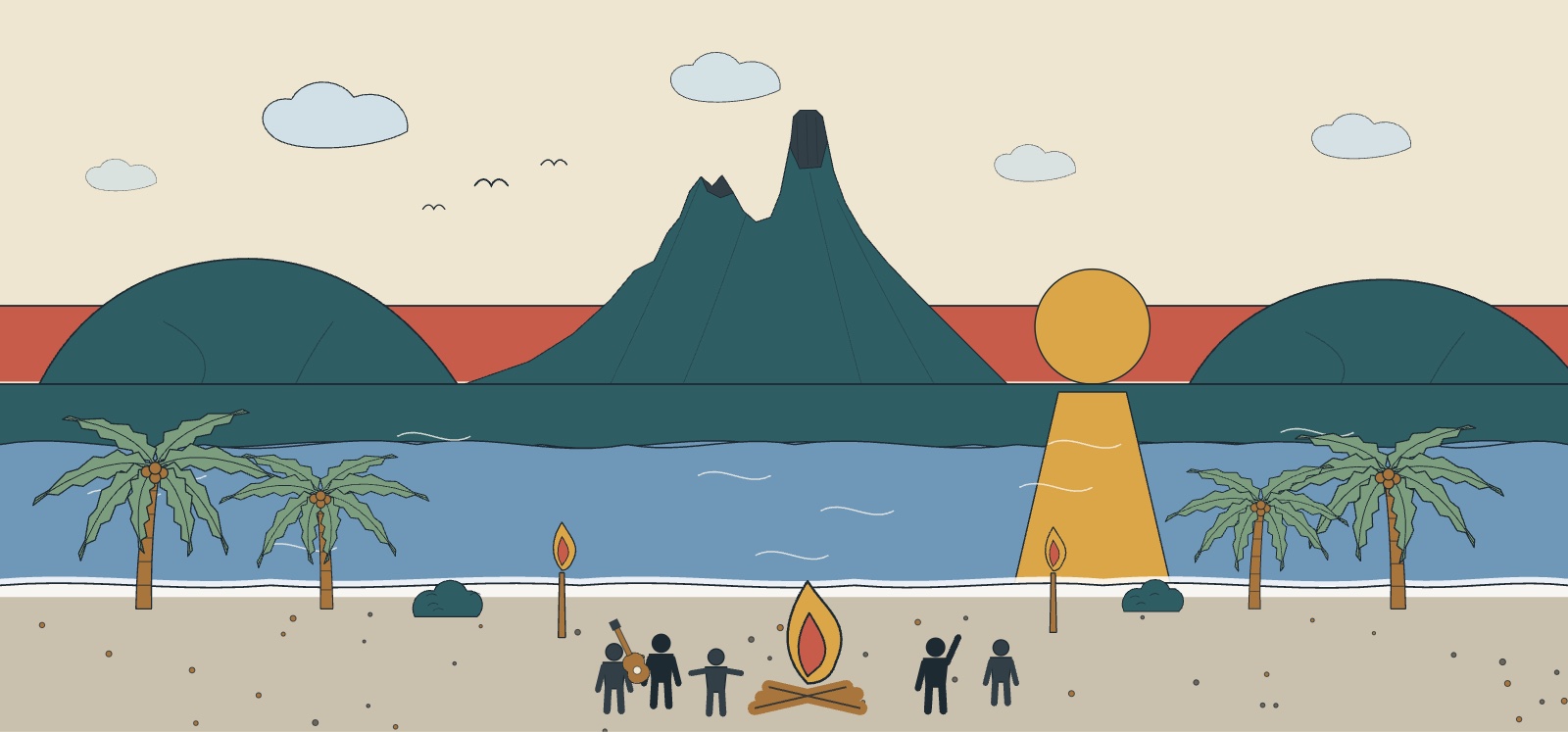
A motu at sunset. Which side of the lagoon you book decides your wind, your light and your transfer time. Illustration : Book Luxury & Premium Hotels in Bora Bora.
One booking note that applies to every month. French Polynesia received 281,227 tourists in 2025, its highest figure on record, which is already above the 280,000 ceiling the territory has set itself. Room supply on Bora Bora does not grow with demand, and July to October fills first. Our note on the visitor cap sets out what that means in practice.
FAQ
What is the best month to visit Bora Bora?
September. It combines dry-season weather, with 2.5 inches (65 mm) of rain over 9.3 days, with rates well below the August peak: the average room across French Polynesia went for $685 a night in September 2025 against $821 in August. Humpback whales are still in Polynesian waters until 20 November, and the sea holds 81 °F (27 °C).
When should you not go to Bora Bora?
December to February. December averages 9.9 inches (251 mm) of rain over 16.8 rainy days, January 9.6 inches (245 mm) over 17.2 days, and both fall inside the November to April cyclone season. Humidity stays high, nights do not cool below 78 °F (25 °C), and lagoon visibility drops after heavy rain. The compensation is the year's lowest rates.
What is the rainy season in Bora Bora?
November to April. Météo-France Polynésie française calls it the warm season, and it delivers 1,158 mm of Bora Bora's 1,654 mm annual rainfall, about 70 percent, in those six months. Rain usually falls as heavy afternoon or overnight bursts rather than all-day drizzle. The dry season runs May to October and takes the remaining 496 mm.
Does Bora Bora get hurricanes?
Rarely. Cyclones in French Polynesia form between November and April, and the territory sits at the eastern edge of the South Pacific basin, well away from the corridor that hits Fiji and Vanuatu yearly. The last storm to damage Bora Bora was Cyclone Oli in February 2010, with gusts to 75 mph (120 km/h) and 40 homes destroyed. The worst season on record, 1982 to 1983, produced six cyclones territory-wide.
What is the cheapest month to go to Bora Bora?
February. The average daily rate across French Polynesia's international hotels was 52,351 XPF, about $503, in February 2025, the lowest of the year and 39 percent below August. January runs the lowest occupancy, at 50.2 percent, which is when resorts discount hardest. Both months are wet: expect 8 to 10 inches of rain and roughly half the days with some.
How warm is the water in Bora Bora?
Between 81 °F (27.1 °C) in August and September and 85 °F (29.4 °C) in April, on NOAA's 2016 to 2025 satellite averages for the lagoon area. The spread across the whole year is four degrees. No month requires a wetsuit, and most snorkelers use nothing at all.
When can you swim with whales in Bora Bora?
From 20 July to 20 November, the dates set by French Polynesia's Department of the Environment. Only operators approved by the department may run trips. Boats must stay 100 metres from the animals, private craft 300 metres, and speed is limited to 3 knots within a 300-metre radius. August to October are the reliable weeks.
How many days do you need in Bora Bora?
Most itineraries pair Bora Bora with Tahiti, because every arrival routes through Faa'a airport in Papeete before the domestic hop. Four to five nights on Bora Bora covers a lagoon tour, a motu day, the inland track and a rest day, with room for the one weather day that a wet-season trip should always carry.